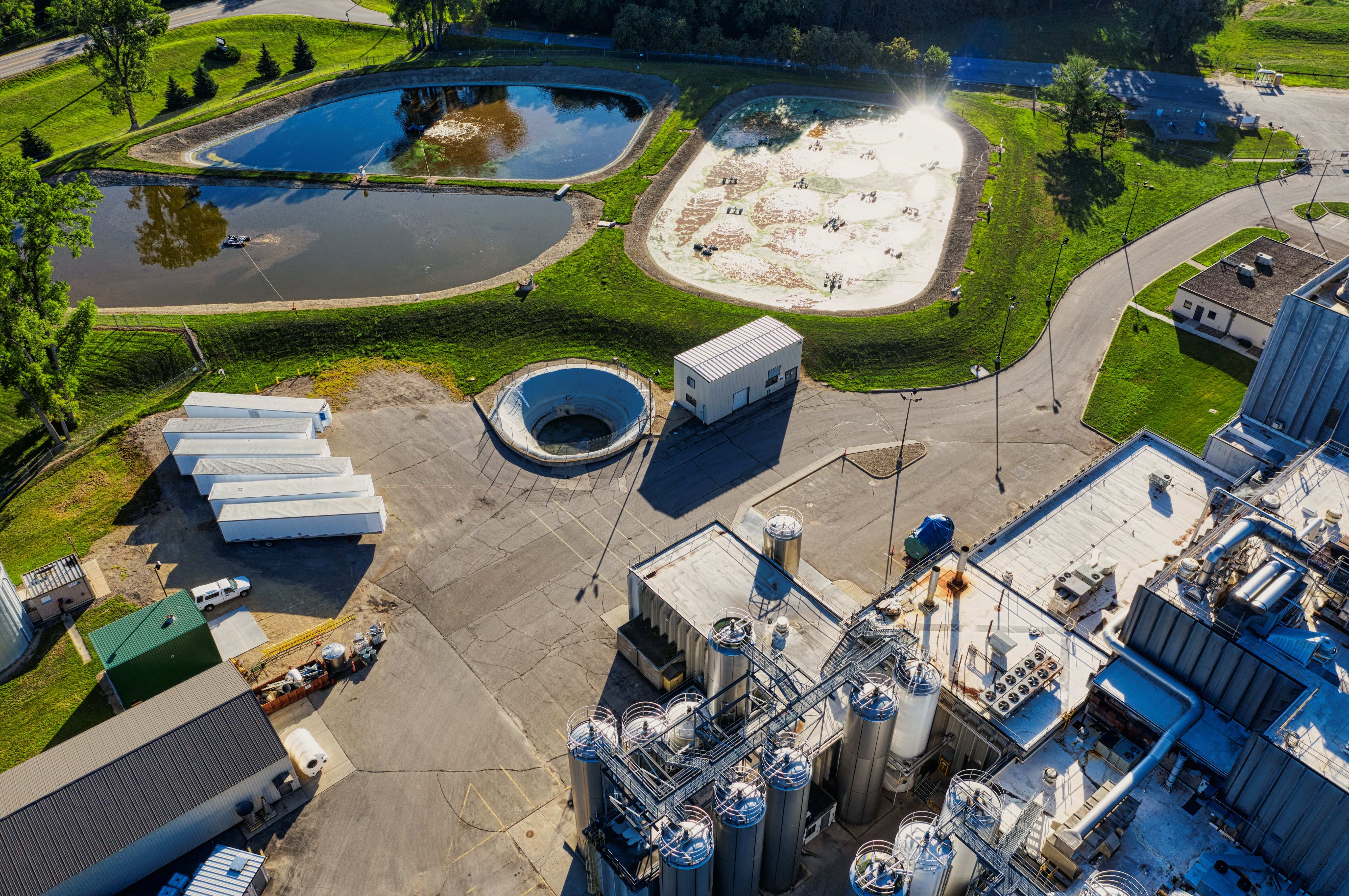
Industry: mining · Country: Chile (anonymised — operator named under NDA) · Surface area: 22,000 m²
92% evaporation reduction measured over 12 months
A 22,000 m² copper tailings storage facility in arid Chile (anonymised at operator request) deployed hexagonal floating covers in early 2025 to reduce evaporative water loss. Twelve months of post-deployment monitoring confirmed 92% evaporation reduction — slightly below the maximum 97% theoretical because of wind-edge effects on the perimeter and small areas around the discharge points where partial coverage was used.
The site
The pond sits in a copper concentrator water-management circuit. Pan evaporation in the region averages 2,400 mm/year. Before cover deployment, annual open-pond water loss was approximately 52,800 m³ — equivalent to roughly 18% of the operation’s total annual fresh-water make-up budget.
The problem
Three operational pressures drove the cover decision:
- Make-up water cost — water in the region was costing the operation €1.20/m³ delivered to the concentrator (including abstraction permit fees and pumping energy). The 52,800 m³ annual loss was costing €63,360/year.
- Community-pressure dust complaints — wind-driven aerosol from the exposed water surface was reaching nearby residential areas, generating complaint volume that the operator’s community-relations team was managing actively.
- Reagent vapour exposure — the cyanide-leach side circuits in the broader operation contributed to monitoring readings at the worker-camp boundary; while readings were within compliance limits, the operator wanted headroom.
The deployment
- Total cover area: 22,000 m²
- Cover type: Patented hexagonal modular HDPE
- Installation duration: 8 working days, 5-person crew
- Installation method: Shoreline launch with self-distribution by water motion
- Reservoir status during installation: Continued service; no draining required
The results
Measured over 12 months post-deployment:
| Metric | Before | After | Change |
|---|---|---|---|
| Annual evaporation loss | 52,800 m³ | 4,224 m³ | -92% |
| Annual water cost saved | — | €58,291 | — |
| Dust complaints (12-month period) | 14 | 1 | -93% |
| Worker-camp boundary monitoring | within compliance | within compliance + 35% margin | improved |
Payback on water cost alone: 17.4 months. The dust-complaint and exposure improvements were operationally material but harder to quantify in pure financial terms.
What the operator said
“The covers paid back within 18 months on water savings alone, and the dust complaints we’d received for years simply stopped after the first deployment week.”
— Operations Director, copper tailings facility, arid Chile
Why this case generalises
Operations with similar profile — arid-region mining tailings, water cost > €1.00/m³, pan evaporation > 2,000 mm/year — typically see payback in the 12–24 month range on water savings alone. The secondary benefits (dust, reagent vapour, regulatory headroom) are pattern-consistent across copper, gold, and lithium-adjacent operations.
See floating cover ROI for mining operations for the project-grade modelling framework.
Related
- Mining industry deep-dive
- Evaporation control
- Hexprotect® AQUA product page
- Floating covers in arid climates
“The covers paid back within 18 months on water savings alone, and the dust complaints we'd received for years simply stopped after the first deployment week.”