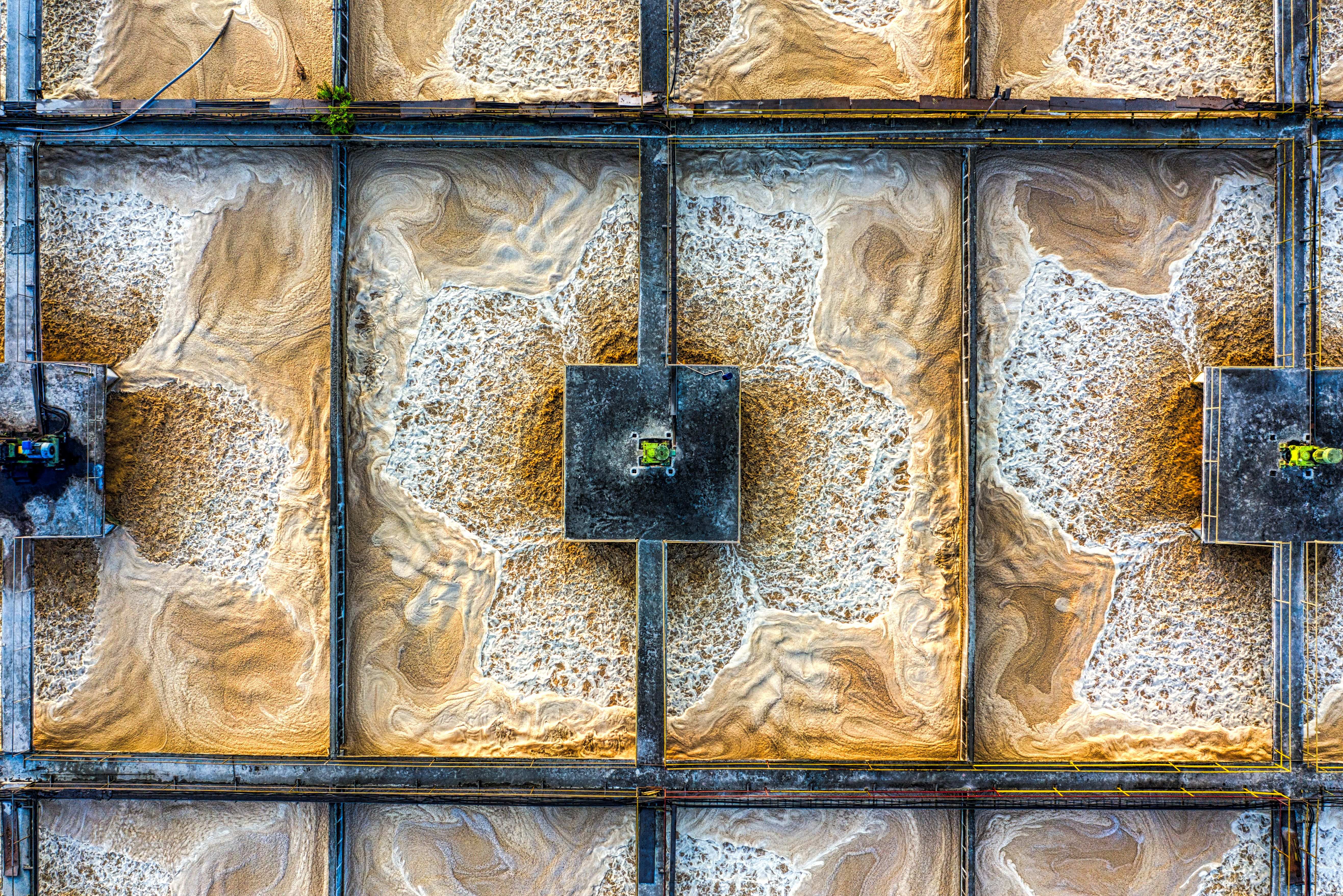
For EU and adjacent mining operations — primarily Spain, Portugal, Sweden, Finland — EuroCover quotes floating covers for tailings storage and process water reservoirs. Payback typically lands inside 12–24 months on water savings alone in arid-climate contexts. EuroCover’s catalog covers both Hexprotect® AQUA and Hexofloat® for this brief.
Why mining operators deploy covers
Tailings ponds and process water reservoirs in arid-climate mining contexts evaporate 1,500–3,000 mm per year — equivalent to 15,000–30,000 m³/year per hectare. For lithium, copper, and gold operations where water is the constraining input, that loss is a significant operating cost. Covers also suppress dust emission from the water surface and reduce chemical exposure at the water-air interface.
Procurement notes for mining
- Active deposition: ring exclusions around the spigot zone are set at install.
- Reagent chemistry: confirm HDPE compatibility at quotation (most cyanide, sulfate, and lime chemistries are within envelope; lithium brine is not).
- Freeze-thaw: confirm site temperature envelope for Scandinavian operations.
For the engineering principle behind the modular hexagonal cover, see pond-cover.com/hexagonal-floating-cover.
Benefits for mining operators
| Metric | Value |
|---|---|
| Evaporation reduction | 90–97% |
| Dust emission reduction | Significant |
| Chemical exposure reduction at water-air interface | Yes |
| Payback period | 12–24 months in arid regions |
| Lifecycle | 25+ years |
When to use covers in mining
- Tailings storage ponds in arid or semi-arid regions
- Lithium evaporation ponds where coverage is differential (partial cover for evaporation-rate management)
- Process water reservoirs
- Heap leach solution ponds (where chemistry permits)
Floating covers vs. mining alternatives
Mining operators considering water-management approaches typically weigh four options:
- Floating cover (hexagonal modular). 90–97% evaporation reduction, 25+ year lifecycle, no anchors, deployable on active reservoirs.
- Geomembrane lining (sub-surface). Addresses seepage, not evaporation. Often used in combination with floating covers.
- Chemical surfactant monolayer. 20–50% evaporation reduction; reapplication every 1–4 weeks; not durable in wind.
- Recycling/treatment. Capex-intensive (typically 10–50× cover capex per m³/day capacity); justified at very high water cost.
For most arid-region mining operations, floating covers deliver the best combination of capex, lifecycle, and operational simplicity. See the floating-balls comparison and the geomembrane comparison for direct head-to-head detail.
Regulatory context
Mining operators reporting under the EU Industrial Emissions Directive, the ICMM Water Stewardship Framework, and increasingly under CSRD water-disclosure requirements benefit from the measurable water savings and emission reductions floating covers provide.